
Loading

Loading
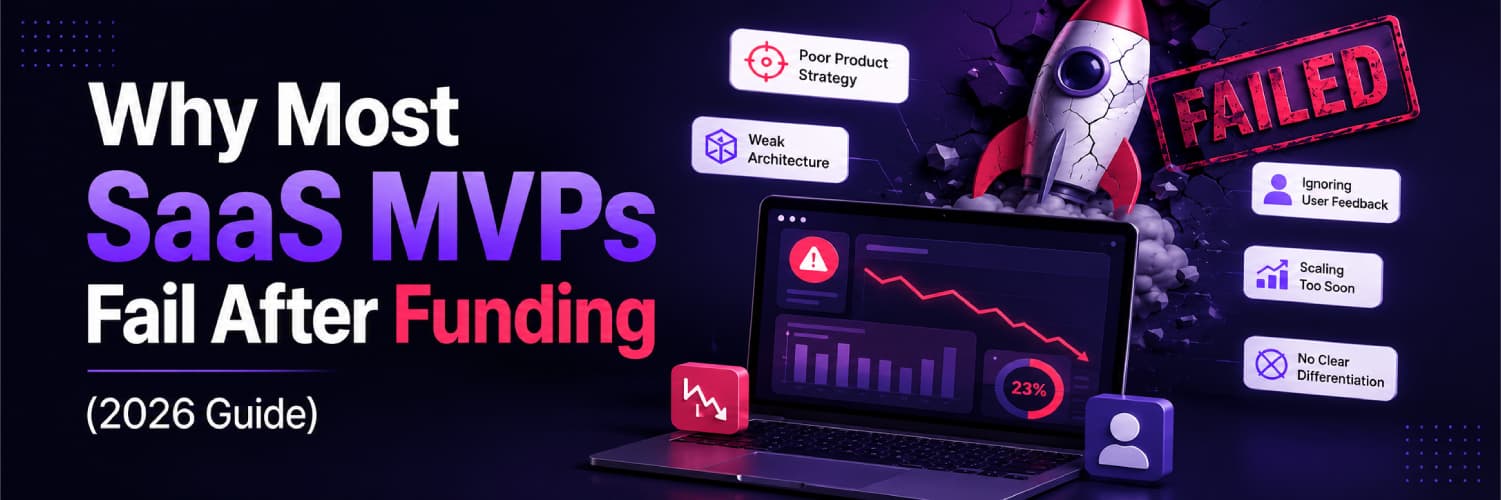
Why Most SaaS MVPs Fail After Funding (And the Tech Mistakes Behind It)

Launching a SaaS MVP is only the beginning of the journey. Many startups successfully build an initial product, acquire early users, and even secure funding — but struggle when the platform starts scaling.
The problem is rarely the idea itself.
In most cases, SaaS MVPs fail after funding because the original product was built for speed, not long-term scalability. As user traffic increases and new features are added, technical weaknesses begin affecting performance, stability, and product growth.
For startups, these issues often lead to:
This is why scalable architecture becomes critical after the MVP stage.

Most MVPs are designed to launch quickly. Founders prioritize speed, investor demos, and early market validation — which is completely normal during the early stage.
However, many startups continue building on the same temporary architecture even after funding.
Over time, this creates:
What worked for 500 users often breaks at 50,000 users.

As SaaS platforms grow, the product becomes more complex.
New features, integrations, dashboards, user roles, analytics systems, and third-party services increase pressure on both frontend and backend infrastructure.
Common scalability problems include:
These issues directly affect customer retention and product experience.

Many SaaS companies focus heavily on backend infrastructure while ignoring frontend scalability.
But frontend performance directly impacts:
Poor frontend architecture often results in:
Modern SaaS platforms require scalable frontend technologies like:
Without proper frontend planning, product growth becomes harder over time.

Technical debt is one of the biggest reasons funded startups struggle after scaling.
In the early stage, shortcuts may help launch faster. But later, those shortcuts often create:
Eventually, teams spend more time fixing old systems than building new features.
This slows product innovation and affects growth momentum.

A SaaS company approached CloudActive Labs after experiencing frontend performance issues and slow feature deployment as their user base expanded.
The platform had:
After reviewing the product architecture, the development team optimized frontend workflows, improved component structure, and streamlined API interactions.
The result was:
For growing SaaS businesses, architecture optimization directly impacts long-term scalability.

The goal of an MVP should not only be launching quickly but preparing for future growth.
Startups should focus on:
Choosing experienced development teams early can help reduce expensive rebuilding later.
As SaaS products grow, technical foundations become just as important as product features.
Final Thoughts
Many SaaS MVPs fail after funding not because the product idea is weak, but because the technical foundation cannot support long-term growth.
Scalable architecture, frontend performance, and maintainable code become critical as user demand increases. Startups that invest early in scalable systems are better prepared for product expansion, faster feature releases, and improved customer experience.
If your SaaS platform is already facing scalability or frontend performance issues, a technical architecture audit can help identify bottlenecks before they affect long-term growth.
Have questions or need assistance? We're here to help! Reach out to us today, and our team will get back to you as soon as possible.