
Loading

Loading
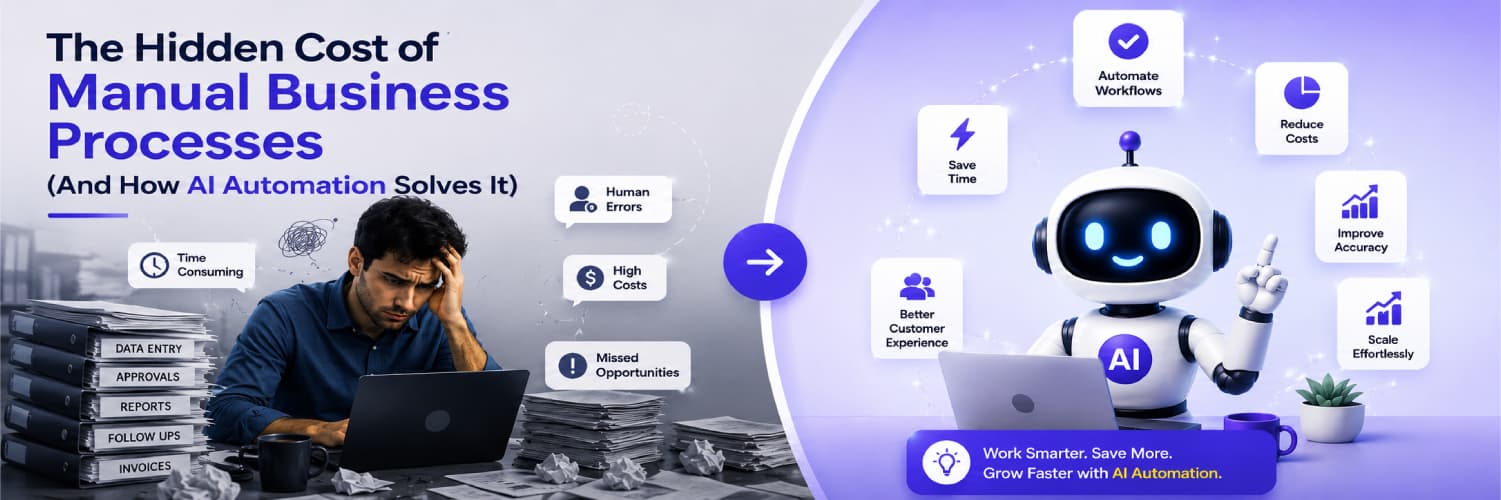
The Hidden Cost of Manual Business Processes (And How AI Automation Solves It)
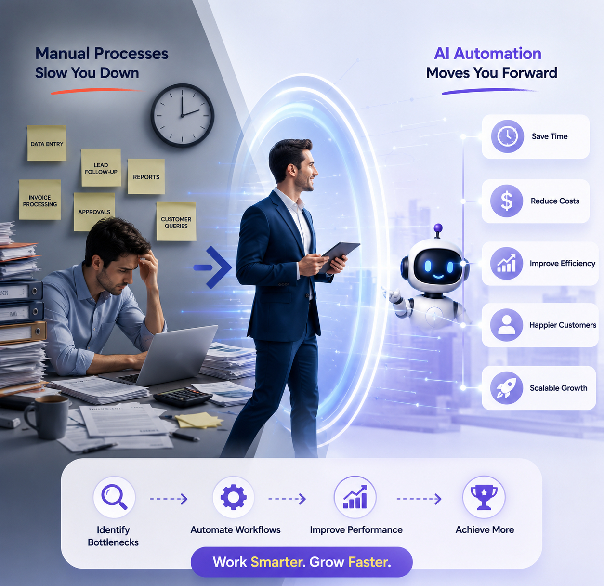
Many businesses don't realize how much time and money they lose to manual processes every day.
Tasks like data entry, lead management, customer support, reporting, invoice processing, and workflow approvals often seem manageable at first. However, as a business grows, these repetitive activities begin consuming valuable time that could be spent on strategic initiatives.
In 2026, companies are increasingly turning to AI automation not because it's a trend, but because manual operations are becoming a major barrier to growth.
The businesses that scale successfully are often the ones that identify operational bottlenecks early and automate them effectively.

Manual workflows may not appear costly when viewed as individual tasks. The real cost becomes visible when these activities are repeated hundreds or thousands of times each month.
Employees spend hours switching between systems, updating records, generating reports, responding to repetitive inquiries, and performing routine administrative work.
Over time, this leads to:
As teams grow, these inefficiencies often multiply across departments.

One of the biggest challenges with manual processes is that they do not scale efficiently.
As customer demand increases, businesses often respond by hiring more staff to handle additional workload. While this may solve short-term capacity issues, it also increases operational expenses.
Manual systems can create bottlenecks in:
Eventually, these bottlenecks begin affecting customer experience and overall business performance.

AI automation helps businesses reduce repetitive work by allowing systems to perform routine tasks automatically.
Instead of manually managing every process, organizations can automate workflows and allow employees to focus on higher-value activities.
Common examples include:
The goal is not to replace employees. The goal is to remove repetitive work that limits productivity.

AI automation is being adopted across nearly every industry.
Sales teams are using automation to manage lead follow-ups and qualification processes. Customer support departments are improving response times through AI-powered assistance. Operations teams are automating internal workflows that previously required significant manual effort.
Businesses are also using AI to:
As AI technology becomes more accessible, automation is becoming a practical business advantage rather than an enterprise-only solution.

Many businesses wait until inefficiencies become serious problems before considering automation.
If your team spends significant time on repetitive activities, manual approvals, data transfers, or routine customer interactions, there may be opportunities to improve efficiency through automation.
The best automation projects often start by identifying tasks that:
These areas often deliver the fastest return on investment.
Final Thoughts
Manual business processes may seem manageable in the early stages of growth, but they often become costly obstacles as operations expand. Repetitive tasks, inefficient workflows, and operational bottlenecks can limit productivity and increase business expenses over time.
AI automation helps businesses streamline operations, improve efficiency, and create scalable workflows that support long-term growth. Companies that proactively automate repetitive processes are often better positioned to improve customer experience, reduce operational costs, and focus on strategic business initiatives.
If your business is spending too much time on manual workflows, identifying automation opportunities today could create significant operational advantages tomorrow.
Have questions or need assistance? We're here to help! Reach out to us today, and our team will get back to you as soon as possible.