

The Ultimate Guide to Headless Shopify Development
A comprehensive, decision-focused guide for modern eCommerce brands, CTOs, and digital leaders evaluating the shift to headless Shopify.Understand the architectural trade-offs, performance benefits, integration potential, and long-term scalability implications—without the hype. Designed to equip teams with clarity, technical direction, and strategic confidence.
Headless Shopify Development: Building High-Performance, Scalable eCommerce Experiences.
A strategic, end-to-end guide for brands and technology leaders evaluating headless Shopify architecture for speed, flexibility, and long-term growth
Traditional Shopify setups struggle to meet the demands of modern eCommerce—multi-channel selling, performance expectations, performance expectations , complex integrations and rapid scale. Headless Shopify offers a future-ready alternative—but only when implemented with the right architecture, tooling, and strategy.
This guide breaks down what actually matters when moving to headless Shopify—without hype, vendor bias, or surface-level explanations.


Why Traditional Shopify Architectures Hit a Ceiling
As brands grow, Shopify’s default architecture often creates limitations:
- Frontend performance tied tightly to backend logic
- Limited flexibility for custom user experiences
- Challenges with scaling across regions, channels, and devices
- Difficulty integrating CMS, ERP, CRM, and analytics tools cleanly
For teams aiming to move fast, experiment freely, and scale reliably, these constraints become blockers—not inconveniences.
Headless Shopify decouples the storefront from the commerce engine, allowing teams to design and scale without architectural friction.
What Is Headless Shopify—Really?
Headless Shopify separates:
- Commerce logic(products, checkout, payments)from
- Presentation layer(frontend, UI, user experience)
Using APIs, brands can:
- Build custom frontends
- Control performance at the code level
- Deliver consistent experiences across web, mobile, kiosks, and more
This approach is especially powerful when paired with:
- Modern frontend frameworks
- Headless CMS platforms
- API-first integrations
At its core, headless Shopify is about control, speed, and future flexibility.

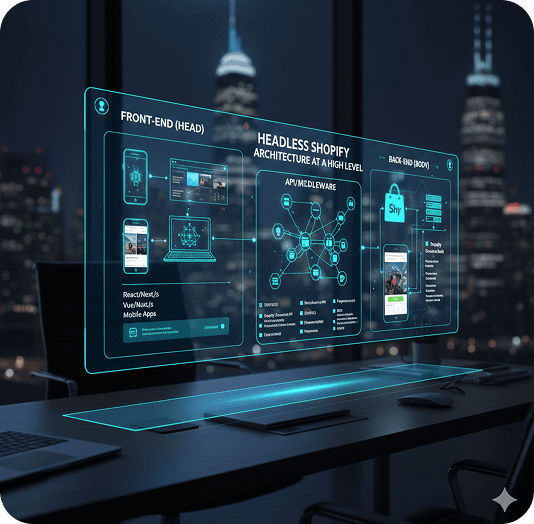
Headless Shopify Architecture at a High Level
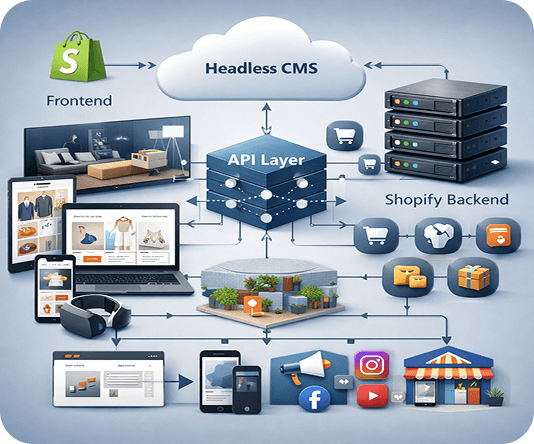
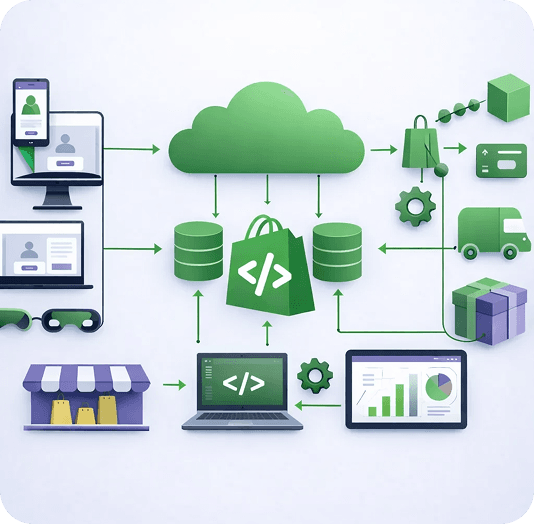
A modern headless Shopify setup typically includes:
- Shopify as the commerce backend
- A custom frontend (often using Shopify Hydrogen or modern JS frameworks)
- A headless CMS for content management
- APIs connecting payments, inventory, CRM, ERP, analytics and marketing tools
This modular architecture allows each layer to evolve independently—reducing long-term technical debt.
By decoupling systems, teams gain flexibility in performance optimization UX experimentation, and global scalability
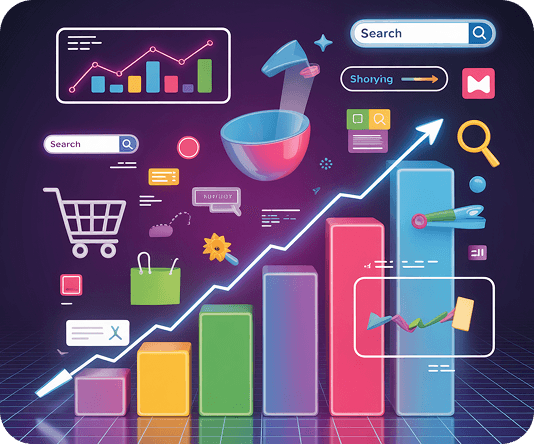
How Headless Shopify Impacts Speed, SEO & Conversions
Well-implemented headless Shopify stores consistently outperform traditional setups when it comes to:
- Page load speed and Core Web Vitals
- SEO flexibility and technical optimization
- Conversion-focused UX experimentation
- Frontend personalization and A/B testing
Performance gains are not automatic—but when architectural decisions are aligned with business goals, the impact becomes measurable and sustained.

Check Your Headless Shopify Readiness
Use our evaluation checklist to understand whether your current architecture, team, and business model are prepared for headless.

Is Headless Shopify the Right Choice for Your Business?
Headless Shopify is not for everyone.
It’s typically a strong fit if:
- Your brand prioritizes performance and UX differentiation.
- You operate across multiple regions or channels.
- Your tech stack includes multiple integrations.
- Your team values long-term scalability over short-term simplicity.
For smaller or early-stage stores, traditional Shopify may still be the better choice.
Common Mistakes Brands Make with Headless Shopify
Some of the most frequent issues we see:
- Over-engineering without clear business goals.
- Ignoring content workflows and CMS strategy.
- Treating headless as a frontend-only upgrade.
- Underestimating long-term maintenance and governance.
Successful headless Shopify projects are led by architectural decisions, not tools alone.
Many of these mistakes originate from weak architecture planning. Read our detailed architecture best practices guide. architecture best practices guide


Our Approach to Headless Shopify Development
At CloudActive Labs, we approach headless Shopify as a business architecture decision — not just a development trend.
- Business-first discovery and technical planning.
- Clear CMS and content modeling strategy.
- Performance-focused frontend architecture.
- Scalable integrations and API orchestration.
Our goal is to build headless commerce systems that are sustainable, measurable, and aligned with long-term growth.
Explore Headless Shopify in Detail
Users can dive deeper into specific areas:
- Architecture & Tech Stack
- Shopify Hydrogen & Custom Frontends
- Performance Optimization
- SEO & Conversion Strategy
- Migration & Implementation Planning
Each topic expands on a specific aspect of Headless Shopify and connects back to this strategic guide.
Get the Complete Headless Shopify Strategy Blueprint
For teams seriously evaluating headless Shopify, we’ve created a comprehensive PDF covering:
- Architecture decisions framework
- Readiness assessment checklist
- Performance planning strategy
- Migration considerations
- Cost & ROI factors
This blueprint is designed for decision-makers — not beginners.
Get the Headless Shopify Strategy Blueprint
A concise, decision-ready PDF covering architecture, readiness, performance, migration, and ROI.