

Cross-Platform App Development Roadmap & Implementation Strategy
Cross-platform app development is often evaluated at a conceptual or architectural level, but success ultimately depends on execution. Without a clear roadmap, even well-designed mobile applications can face delays, performance issues, and scalability challenges. A structured implementation strategy ensures that cross-platform mobile apps are built efficiently, aligned with business goals, and ready to scale across platforms and user bases. This page outlines how to plan, design, and implement cross-platform applications—from initial strategy to deployment and ongoing optimization.
Why a Structured Development Roadmap Matters
Many teams approach cross-platform app development as a straightforward build process. In reality, it requires careful planning across architecture, frameworks, performance, and scalability.
A structured roadmap helps:
- Reduce development risks
- Align product and engineering teams
- Improve development efficiency
- Avoid costly rework and delays
- Ensure long-term scalability
Without a clear roadmap, mobile projects often struggle with performance issues, inconsistent UX, and integration challenges.


Phase 1 — Strategy & Requirement Planning
The first phase focuses on defining product goals, technical requirements, and business objectives.
Key Activities
- Define target platforms (iOS, Android, or both)
- Identify user needs and core features
- Evaluate cross-platform vs native requirements
- Define performance expectations
- Plan integrations with backend systems
This phase sets the foundation for all future development decisions.
Phase 2 — Architecture & Framework Selection
Once requirements are clear, the next step is to design the application architecture and select the appropriate framework.
Key Considerations
- Choosing between React Native, Flutter, or other frameworks
- Designing API-driven architecture
- Defining data flow and state management
- Planning scalability and modularity
- Aligning frontend and backend systems
Strong architectural planning ensures that the application remains scalable and maintainable.

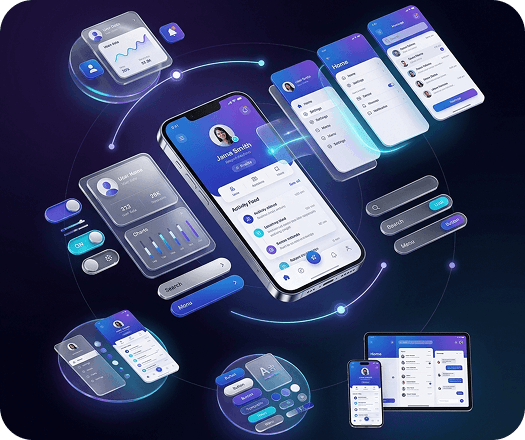
Phase 3 — UI/UX Design & Development
This phase focuses on designing and building the user interface and application features.
Key Activities
- Designing consistent UI across platforms
- Building reusable components
- Implementing navigation and user flows
- Ensuring responsive and adaptive layouts
- Testing user experience across devices

Plan Your Mobile App Development the Right Way
Use our roadmap checklist to evaluate your development strategy, architecture planning, framework selection, and scalability readiness.
Phase 4 — Integration & Backend Development
At this stage, the mobile application is integrated with backend systems and third-party services.
Key Activities
- API integration and data synchronization
- Authentication and security implementation
- Integration with payment gateways, analytics, and external tools
- Backend performance optimization
- Error handling and monitoring
A strong backend integration ensures reliability and scalability.


Phase 5 — Testing, Optimization & Deployment
Before launch, applications must be thoroughly tested and optimized.
Key Activities
- Functional testing across platforms
- Performance testing and optimization
- Device compatibility testing
- Security validation
- App store deployment (iOS & Android)
Testing ensures that the application delivers a smooth and reliable user experience.
Phase 6 — Post-Launch Scaling & Optimization
After deployment, continuous improvement is essential for maintaining performance and scalability.
Key Activities
- Monitoring app performance and usage
- Rolling out updates and new features
- Scaling backend infrastructure
- Improving UX based on user feedback
- Maintaining security and compliance
Cross-platform apps allow faster updates and continuous iteration.


Common Implementation Mistakes to Avoid
Some common mistakes include:
- Skipping proper planning and requirement analysis
- Choosing frameworks without architectural clarity
- Ignoring performance optimization early
- Poor API integration and backend design
- Lack of testing across real-world conditions
- No long-term scalability planning
Avoiding these mistakes ensures a smoother development process and better product outcomes.
How This Roadmap Fits Into the Bigger Strategy
Implementation is only one part of a successful cross-platform mobile strategy. It must align with architecture, framework selection, performance optimization, and long-term scalability planning.
This page focuses on execution. A broader strategic perspective is covered in our complete cross-platform app development guide.

Build and Scale Your Cross-Platform App with Confidence
Download the roadmap checklist used by teams to plan, execute, and scale mobile applications efficiently.