

Cross-Platform App Architecture: Frameworks, APIs & Best Practices
Cross-platform app development is not just about writing code once and deploying everywhere—it is about designing a scalable mobile architecture that balances performance, flexibility, and long-term maintainability. As mobile ecosystems grow more complex, architectural decisions determine whether an application can scale efficiently across platforms, integrate with backend systems, and deliver consistent user experiences. This page explains how cross-platform app architecture works at a practical level, the role of frameworks and APIs, and the best practices teams should follow when building scalable mobile applications.
What Makes Cross-Platform Architecture Strategic (Not Just Development)
Many teams approach cross-platform app development as a framework decision—choosing between React Native or Flutter. In reality, the success of cross-platform applications depends on architectural planning, not just tooling.
Cross-platform architecture introduces:
- Separation between UI, business logic, and backend systems
- API-driven data communication
- Shared logic across multiple platforms
- Independent scalability of frontend and backend layers
- Flexibility to evolve features without rewriting applications
When these elements are properly designed, mobile applications become scalable and maintainable rather than constrained by early decisions.
.png&w=1080&q=75)
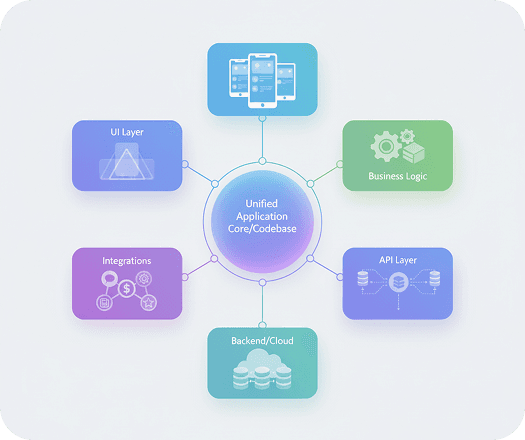
Core Components of Cross-Platform App Architecture
A modern cross-platform mobile app architecture typically includes:
Mobile UI Layer - Built using frameworks like React Native or Flutter, this layer handles user interaction and visual rendering across devices.
Shared Business Logic Layer - Core application logic, including data processing, validation, and workflows, is shared across platforms to improve efficiency and consistency.
API Layer - APIs act as the bridge between mobile applications and backend systems, enabling secure and scalable data exchange.
Backend Infrastructure - Cloud-based systems, databases, authentication services, and integrations power the application and support scalability.
Each layer operates independently while remaining connected through well-defined interfaces, ensuring flexibility and long-term scalability.
Role of Frameworks in Cross-Platform Architecture
Frameworks play a critical role in how cross-platform applications are built, rendered, and maintained. However, they are only one part of the architecture.
Key frameworks include:
- React Native → Uses native components with JavaScript
- Flutter → Uses a custom rendering engine with Dart
- .NET MAUI → Integrates with Microsoft ecosystem
- Kotlin Multiplatform → Shares logic with native UI
Each framework impacts:
- UI rendering performance
- Development workflow
- Integration capabilities
- Long-term scalability
Framework selection should align with architectural goals—not just developer preference.


API-Driven Mobile Architecture
Modern cross-platform applications rely heavily on API-driven architecture.
Instead of tightly coupling frontend and backend systems, APIs allow mobile apps to communicate with backend services in a flexible and scalable way.
Key benefits include:
- Platform-independent data delivery
- Faster development and iteration cycles
- Easier integration with third-party services
- Improved maintainability and scalability
A well-designed API layer ensures that mobile applications can evolve without major architectural changes.

Check Your Cross-Platform App Architecture Readiness
Use our architecture checklist to evaluate framework selection, API design, mobile performance, scalability, and development workflows.
Common Cross-Platform Architecture Mistakes to Avoid
Some of the most common mistakes teams make include:
- Treating cross-platform development as a frontend-only solution
- Poor separation of concerns between layers
- Overloading APIs with unnecessary data
- Ignoring performance optimization early
- Choosing frameworks without long-term planning
- Lack of scalability and monitoring strategy
Avoiding these mistakes is critical to building reliable and scalable mobile applications.


When Cross-Platform Architecture Makes Sense
Cross-platform architecture is most effective for organizations that need to:
- Build applications for both iOS and Android
- Scale mobile products quickly
- Maintain consistent user experiences
- Optimize development and maintenance costs
- Integrate with complex backend systems
For applications requiring extremely high performance or deep hardware integration, native development may still be more suitable.
How This Architecture Fits Into the Bigger Picture
Cross-platform architecture is only one part of building successful mobile applications. Performance optimization, framework selection, development workflows, and long-term scalability must all align with architectural decisions.
This page focuses on architectural foundations. A broader strategic perspective is covered in our complete cross-platform app development guide.

Ensure Your Mobile App Architecture Is Scalable
Download the checklist used by development teams to validate cross-platform architecture, API strategy, and long-term scalability planning.