

The Ultimate Guide to Cross-Platform App Development
Build powerful mobile applications that run seamlessly across iOS and Android from a single codebase. Reduce development time and cost while maintaining high performance and native-like experiences. Scale faster with flexible, future-ready cross-platform app development solutions.
Authority Opening (Above the Fold)
Cross-Platform App Development: Building Scalable, High-Performance Mobile Applications Across iOS and Android
A strategic, architecture-focused guide for businesses, startups, and technology leaders evaluating cross-platform mobile app development for scalability, performance, and faster time-to-market.
Traditional mobile app development requires building separate applications for iOS and Android, leading to increased development costs, longer timelines, and complex maintenance cycles. As digital products evolve, this approach becomes increasingly difficult to scale.
Cross-platform app development addresses this challenge by enabling organizations to build high-performance mobile applications using a shared codebase, modern frameworks like React Native and Flutter, and API-driven architectures.
However, cross-platform development is not just a cost-saving approach—it is an
This guide explains how cross-platform app development works, when it makes sense, and how organizations should approach it strategically.
.png&w=1080&q=75)

Why Traditional Mobile Development Falls Short
Traditional native app development introduces several limitations as products scale across platforms and user bases.
Building separate native applications often results in:
- Duplicate development efforts across iOS and Android
- Increased engineering and maintenance costs
- Slower feature releases and updates
- Inconsistent user experiences across platforms
- Complex integration and backend dependencies
As mobile ecosystems expand, these limitations reduce agility and slow down product innovation.
What Is Cross-Platform App Development—Really?
Cross-platform app development refers to building mobile applications that run on multiple operating systems using a shared codebase.
Instead of developing separate apps using Swift or Kotlin, developers use frameworks like React Native, Flutter, and .NET MAUI to build applications that work across platforms.
This approach enables:
- Code reusability across iOS and Android
- Faster mobile app development cycles
- Consistent UI and UX across devices
- Reduced long-term maintenance complexity
- Scalable mobile product architecture
At its core, cross-platform development is about efficiency, flexibility, and long-term scalability—not just speed.


Cross-Platform App Architecture at a High Level
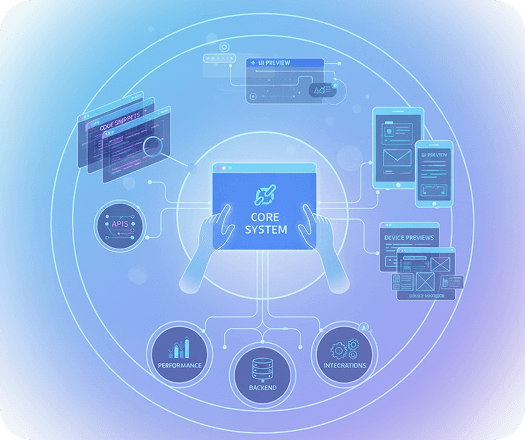
Modern cross-platform applications rely on modular, API-driven architectures that separate frontend, logic, and backend systems.
A typical cross-platform app architecture includes:
- Mobile Application Layer UI and user interaction handled via frameworks like React Native or Flutter
- Shared Business Logic Layer Reusable code across platforms for faster development and consistency
- API Layer Handles communication between mobile apps and backend services
- Backend Infrastructure Cloud-based systems, databases, authentication, and integrations
This architecture ensures flexibility, scalability, and maintainability as applications grow.

Check Your Cross-Platform App Readiness
Use our readiness checklist to evaluate your mobile architecture, framework selection, performance strategy, and scalability readiness.
Why Cross-Platform Apps Enable Faster Growth
Cross-platform development directly impacts product growth, scalability, and user experience.
Well-implemented cross-platform apps enable:
- Faster time-to-market for mobile applications
- Reduced mobile app development costs
- Consistent user experience across devices
- Easier updates and feature rollouts
- Scalable mobile app architecture for growing businesses
These benefits are especially valuable for startups, SaaS platforms, eCommerce apps, and enterprise mobile solutions.


Performance, UX & Scalability Considerations
Performance is often the biggest concern when evaluating cross-platform app development.
Modern frameworks like Flutter and React Native have significantly improved performance through optimized rendering, native components, and efficient data handling. However, performance depends on architecture and implementation —not just framework selection.
Key factors include:
- Efficient API communication
- Optimized UI rendering
- Scalable backend systems
- Proper state management
- Performance monitoring and testing
When implemented correctly, cross-platform apps can deliver near-native performance for most use cases.
When Cross-Platform Development Makes Sense
Cross-platform app development is most effective when:
- Applications need to run on both iOS and Android
- Faster development and deployment are required
- Budget optimization is a priority
- Consistent UX across platforms is critical
- Scalability and long-term maintenance are important
However, native development may be better for:
- High-performance gaming apps
- Advanced AR/VR applications
- Hardware-intensive mobile applications
Choosing the right approach depends on product goals and technical requirements.


Common Mistakes in Cross-Platform App Development
Some common mistakes teams make include:
- Treating cross-platform as only a cost-saving solution
- Choosing frameworks without architectural planning
- Ignoring performance optimization early
- Poor API and backend design
- Lack of scalability planning
Avoiding these mistakes is critical for building reliable mobile applications.
How CloudActive Labs Approaches Cross-Platform App Development
At CloudActive Labs, we approach cross-platform app development as a strategic product and architecture decision—not just a development task.
Our focus includes:
- Scalable mobile app architecture
- React Native and Flutter expertise
- API-driven development
- Performance optimization
- Long-term product scalability
This ensures that mobile applications are not only built efficiently but also designed for growth.

Explore Cross-Platform App Development in Detail
Cross-Platform App Development Explained: Architecture, Frameworks & Scale
Composable Mobile Architecture with Cross-Platform Frameworks
How Cross-Platform Apps Improve Performance, UX & Scalability
Cross-Platform vs Native App Development: A Strategic Comparison
Cross-Platform App Development Roadmap & Implementation Guide
Get the Complete Cross-Platform App Strategy Blueprint
A decision-ready PDF covering mobile architecture, framework selection, performance optimization, scalability planning, and development strategy.